| Feb 02 |
Author ArchiveOMFG It’s 1984 in a box
Garageband, Apple’s basic, mass market music recording software, has had a whole new tutorial module attached, along with some upgrades to the guitar amps, but it’s the tutorials that are the outstanding thing. Although there aren’t very many of them – you can see it’s a tentative early days implementation – but what there is is pretty fantastic. You’ve got 9 lessons for both guitar and piano and each one lasts 5 – 10 minutes. You have a video lesson, complete with music notation and a mockup of either the piano keyboard or the guitar fretboard, then you can play a song along with prearranged accompaniment. So far I’m about halfway through both and I’ve learnt a couple of key things as well as being able to play Ode To Joy along with what sounds like a rather half arsed oompa band and some basic blues. It’s great. The tutor, Tim, is all Apple cool, but effective nonetheless and the format is great. The only downside is that there are so few lessons. I can see myself wanting more comprehensive ones pretty damn soon. Actually that’s not the only downside. In keeping with its iTunes Store and the iPhone AppStore, Apple has launched a Lessons Store for these lessons, and while the initial ones are free, the idea is obviously to charge people for additional lessons, including lessons teaching you how to play ‘popular’ songs featuring the people who wrote them. And while I don’t have a fundamental problem with this, the current execution is terrible. You have to think that a supposedly hip company like Apple would have been able to sign up some proper stars, rather than the dross that’s featured here – Sting being the only one I even recognise. It’s a very short line up of, I guess, Gap style blands like Ben Fold. Again I suspect that this is a case of a featured rushed out slightly before its time. Next update let’s hope they bring us the likes of Radiohead etc. Also at £3.45 it’s a little too expensive. The other major upgrade is iPhoto and I’m not sure whether to be amazed or afraid with its latest feature, Facial Recognition. To use it you identify a particular individual’s face (the programme’s intelligent enough to identify faces themselves) and iPhoto takes it from there, showing you additional images that it thinks might be that person. The more images of the person you identify, the better iPhoto gets at identifying them. I spent a lot of Saturday going through my images and I was gobsmacked. It’s a fantastic feature. It is also profoundly scarey. Imagine, this is a consumer application that can go through my not inconsiderable iPhoto library in less than 10 minutes identifying all the faces (and admittedly some elbows, hands and other bits and pieces, but by and large faces). It’s then able to sort those faces based on my input confirming the identity of various people. And its suggestions are, pretty much, accurate, it’s able to separate me at various ages from my family at various ages and it throws up relatively few errors. And this is what consumers get. For less than £60. Imagine what the spy community gets! Imagine how much more accurate and swift that software is. Imagine being able to scan, sort and identify an entire airport of users in seconds, being able to track people through traffic and security cameras, I used to think it was as unlikely as Tony Scott’s Enemy Of The State. Now, I’m not so sure. And mapping people couldn’t be easier. Assuming I have a camera with GPS, iPhoto will even arrange my photos by location. So I can theoretically follow someone, identify them and have a series of photos that show where they’ve been going. And while I can see numerous great family uses for these features, they raise some sinister questions. |
 Just been playing around with Apple’s new iLife package. Overall it comes off as a bit of a halfway house, only Garageband and iPhoto seem to have had any real work done to them, while iWeb and iMovie have barely been touched. However, the changes to both iPhoto and Garageband are pretty amazing.
| Jan 29 |
Author ArchiveWhat I Learnt From BUG Today
The Safe Zone is here at BUG. It’s all over the place. The signs could not be clearer. Everywhere I look, whether it’s ‘Handfed‘ by Above The Sea, or ‘Caskets‘ by Damien Jurado the Safe Zone is in your face. It’s a fucking wood cabin out in the middle of nowhere watched over by a moody time-lapsed sky and home to the most arid colour palette this side of Quantum of Solace. And even here it’s not bloody safe. Instead of the everyday nuclear catastrophes of imploding economics and spending something like five hundred grazillion pounds on bankers, the Safe Zone is full of burning houses, dead people on telephones and really primitive medical operations. Hardly a haven of tranquility. And even if we’re not being burned, gassed, anaesthetised and buried alive we’re still surrounded by horror and ghastliness. An exploding thermocline of what looks like badly applied wall filler threatens to sandblast crap Scotch tossers Glasvegas. I’d put a link in but a) the video and the song are bloody dreadful and b) it’s on a site run by Carling, who even if I bothered to drink alcohol, I wouldn’t touch with someone else’s ulcerated liver. Glasvegas are everything that’s wrong with major label bands. More bloated and festering than U2 ever were (although I may change my mind when the U2 album finally emerges), Glasvegas are like Guns n’ Roses without BOTH Slash and Axel. Glasvegas aside, the rest of BUG 11 is class. Rex the Dog‘s ‘Bubblicious‘ is class stopframe animation (which leads to the bizarre ‘Rex The Dog cooks dinner for Goldfrapp‘, which in turn shows that there’s no place for weirdness that can’t be found on YouTube). zZz‘s ‘Running With The Beast‘ is the most perfect homage to the late Tony Hart, the sort of action painting extravaganza that encourages young children to take up art as a career along with vegetarianism. And there are laughs aplenty as vaguely-too-old-to-be-doing-it Metallers Red Fang take on the might of the local Dungeons and Dragons reenactment society and come off covered in Monty Python gore in ‘Prehistoric Dog‘. As the comments on YouTube say, “They remind me of Mastodon but better”. And frankly, that’s pretty damn good. At least better than Mastodon. Previous BUGs have always included a few interviews with video directors, this one didn’t because we had missed the first showing (BUG 11a) due to lax ticket purchasing behaviour and had to put up with no directors. However, this was actually a good thing as many of them aren’t very interesting and when they are being interesting they require audience participation from Downstairs Charles, which surely can’t continue. Instead we get a view into Adam Buxton’s laptop, which features premature ejaculation, copraphelia and bloody big Monster Trucks shrunk down into teeny weeny modelmaker view and set to music by Myrobotfriend. And while I can live without the first two thank you very much, the Monster Trucks were fucking great. YouTube commentators once again reveal the real truth, “This is incredible,” they say, “The focus and wide angle make everything look like scale models. This video broke my brain.” |
 Fundamentally, we’re all fucked. We’re fucked and we’d better run. Not, as Nick Cave would have it, to the City of Refuge, because that’s toast, that’s yesterday’s safe point and brother, it ain’t safe no more that’s for goddamn sure. No, if I’m reading the subtext of BUG 11 (The Director’s Cut) right – and I like to think that I’m reading it right – we’ve all got a whole load more running to do to get to the Safe Zone.
| Jan 25 |
Author ArchiveWarhorse and war stories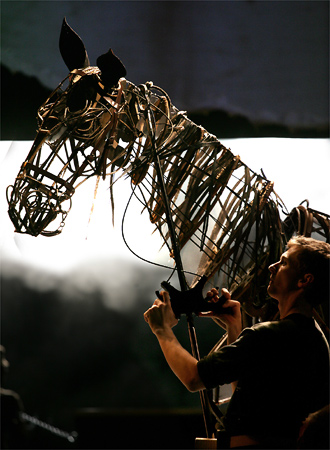 WarHorse head shot Went off to see WarHorse at the National Theatre with my Mum, which we’d both been very excited about for months (that’s how long you have to wait for tickets). It’s a great combination of animal puppetry and mechanical sets that is let down by a fairly one dimensional script and some pretty average acting. So a bit like Pearl Harbour or, frankly, every Michael Bay movie. The puppets are fantastic, although calling them puppets does them a great disservice as it conjours up images of poncey wire-controlled oldies like Andy Pandy and Pinocchio. The animals here are more like Stan Winston anamatronics but without any of the computerised bits and pieces. And it’s amazing how these skeletal segments of horse quickly become as emotive and lifelike as the real things. All of which makes the story and the acting that much more unimpressive. There’s something fundamentally lacking in the story, namely any sense of conflict or drama (or indeed antagonist and protagonist). It’s like one of those incredible animal stories where the Dog and the Cat and the Mouse are unceremoniously granny dumped by their once loving owners and have to somehow trek hundreds of miles through the wilderness to find their way miraculously to the family’s new home three states away. As the trio romp their way across scenic views of middle America you realise that there’s something fundamentally missing, it’s just a progression of scenes as narrated by a six year-old. “And then the mouse does this and then the cat did that and..” A flat plateau of stuff happening before your eyes. Events acted out with no depth or dimension, devoid of meaning or import. And while that’s OK for messers Dog, Cat and Mouse and their six year-old wild eyed audience, it’s a bit tedious in a full on play for older people. Robert McKee in Story explains that all story is essentially conflict and that all character is defined by action. It’s the central tenet of story that the characters change and evolves as a result of their activities throughout the story and that these changes are the result of their own actions. Stuff doesn’t simply happen to characters, they’re not flotsam at the mercy of events. This simply reinforces the sense of emptiness in WarHorse. There are few characters who are in conflict and there’s certainly no protagonist or antagonist driving the story. Which means there’s really no development of character, no change in state and no sense of resolution. Sure Joey, the WarHorse of the title, is sold, goes off to war and, ultimately comes back, but it’s just a progression of events with no meaning behind it. Joey doesn’t change, isn’t changed by his experiences and neither are any of the characters we see. Ultimately you feel wholely unmoved as everyone just slots back into the lives they had before the war. And it illustrates to me the profound lack of quality in the theatre. If this is supposed to be great quality theatre, then why do I end up just feeling emotionally uninvolved? Why is this less satisfying than a good DVD? Is it because the acting is all big mouthed and over-alliterated speech patterns – ‘I say, can you hear me actoring at the back?’. You get the distinct impression that all the actors here are refugees from the harder world of television (and the unachievable world of film). It’s no wonder that real actors are able to wipe the floor with these people. All of which makes the puppetry all the more astounding. These puppets each have more character in them than all the actors combined, the stage set has more imagination than the cast. Which brings me to another really irritating thing about the National and the South Bank as a whole. The one thing I really wanted to do afterwards was sit down, have a drink and talk about the play. What does the National do? Same as the BFI, same as the whole South Bank, it shuts the bars and funnels its audience out into the night, which is essentially the same thing as telling them all to fuck off home because there’s nowhere to go on the South Bank after about 10pm (arguable to say there’s nowhere to go before 10pm either). It just seems mad to me. Why not keep the bars open a little longer, suck up the last vestiges of cash from your punters and encourage them to enjoy the social experience of going out rather than sending them home with a slap round the head and the ring of contempt in their ears? Sure, not everyone would stay, but some of the people who’d come with friends might actually enjoy the experience a little more. |
| Jan 11 |
Author ArchiveFear of Music
When I originally saw it I just thought it was a useful sort of anthology present thing that at £4 was an easy win, but on reading it I just got sucked in. Not just because Mulholland’s initial choices for albums pretty much matched my musical indoctrination, but because the writing was just so damn good. It not only gives you a sense of what each album’s like, but the conditions under which it was made and puts it into some sort of historical and musical context. That way I’m genuinely intrigued about albums I really haven’t been bothered with, like the Dexy’s Midnight Runners one or Kate Bush’s The Dreaming. It’s not simply this, but it’s the appearance of some pretty obscure records that I can remember listening to a lot while I was growing up, like the first Roxy Music Greatest Hits album or Christina’s version of ‘Is That All That There Is’, which in the aftermath of punk were something of a revelation for me. It’s a selection that gives you that strange internal wink that says, ‘Yes I was there and even though only 3 people liked this record, it was one of my favourites’, the shared secrecy of musical obsession. And it’s Mulholland’s understanding of the year zero effect of punk on people’s musical tastes that is so impressive. His thesis that punk was about the elevation of the guitar and the intoxication of the live experience and that the mid 80’s saw a corresponding elevation of bass and rhythm hadn’t occurred to me, but seems patently obvious once you consider it. The great thing about books like this is that you can see trends slowly appearing through time as punk collapses, pop emerges and rap and dance music evolve. It reminds us in retrospect what a divergent time the mid 80’s was, with UK indie music going all jangly and arpeggio, rap just beginning to find its feet and American guitar music preparing the way for the grunge revolution of Nirvana. As with all these books, your own journey and the author’s start to diverge as Mulholland gets engrossed by rap. As a result he misses out of a pile of my personal favourites, The Young Gods album, Underworld’s ‘Dubnobasswithmyheadman’, Nirvana’s ‘Nevermind’, The Stone Roses’ debut and others, classics all and certainly head and shoulders above some of the later inclusions. Even so, as a whole Fear of Music does the most incredible thing, it makes you genuinely excited by music and, at a time when the shuffle button of your mp3 player has competely changed the way we listen to music, it makes the concept of the album as a coherent entity, rather than as a series of discrete tracks, viable again. |
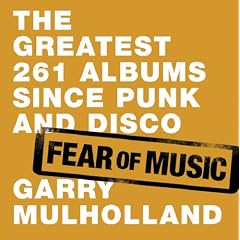 I’ve been frantically reviewing and relistening to loads of old albums since Christmas. Seeking out tracks like Mongoloid by Devo (the first song my first band ever attempted to learn – with catastrophic effects), the first Dexy’s Midnight Runners album, classic Kraftwerk and a pile of others. Why? You ask. Because of this outstanding doorstop of a book.
| Dec 05 |
Author ArchiveNo This Isn’t For You Either
So on the surface it seemed like a vaguely good idea no? Cello n decks n macs n probably not much rock n roll. All in some newish venue in the rapidly emerging from its own cesspit of filth metropolitan giggidge zone that is Kings Cross. Oh pity the poor fuckers because we’ve been well and truly done over. Turns out the only thing that’s changed about Kings Cross is the method of the mugging. You’re still going to come away poorer and with a sore head, but it’s been done with near tenner a time tickets and some godforsaken neo-classicist musical bullshit, instead of with a rusty blade and some barely coherent English. The venue, the unappropriately named Kings Place, couldn’t be more antiseptically impersonal if you doused it with Dettol and stuck its arse in Wallpaper*. I guess it’s trying to be like the Guggenheim NYC crossed with an E-Z Kleen police state interior. Unfortunately it just reminds me of Damien Hurst’s really bad period, where he whiplashed between polka dot painting and trying to build his own pharmacy in a box and sell it as art. So it’s white shiney and very, very plastic. That would all be acceptable if the noise lived up to the promise. I can see Bach cello suites (a personal favourite) being magnificently messed with and bashed around by some kick arse deep beats, then flipped back on itself with the cello somehow coming out on top. Sadly the reality is that we get some well played suite stuff, which is then timidly fluffed about with like some I guess now 10-year-old trying to get their rocks off for the first time, but not even getting to tongues. Normally you’d just shout encouragement from the sidelines, but somehow you sense the inner embarrassment of the poor chap who’s only just got into double figures and feels so intensely pressurised to get it on. Frankly it’s far better to look the other way and hope the little fellow realises the futility of his actions and goes on home to his tea. Now I’ve seen groups messing round trying to figure out what a sampler’s for and what’s the point of it anyway. I’ve seen Einsteurzende Neubauten reduce the ICA to snivelling art whore wreckage. I’ve seen Frank Zappa play for (fuck me was it really) six hours and, you know, really felt every one of those hours weighing down on me like a cement collarbone. So, I guess I feel I can take it, whatever it is, although I draw the line at fretwank jazz bullshit for obvious reasons. So this, this little rabbit scared recital was easy to work through. I just let it wash over me and treated it with the contempt it deserved by drowsing off and gently snoring in time to the overindulgent head posing of the cellist. I have to say that if you’re going to pretend that you’re doing something majorly ambitious and profound with turntables you probably should listen to some classic pre-Gangsta rap records or maybe hang out with our 10-year-old friend, who for all his sexual ineptitude has been fucking with vinyl for at least half his natural life and has elevated that to beastly godliness. Then you can talk to me about how you’re pushing the envelope by whipping three records together over the course of 15 minutes. Til then. Kiss my arse. Puma. |

| Nov 22 |
Author ArchiveCopper Sulphate house
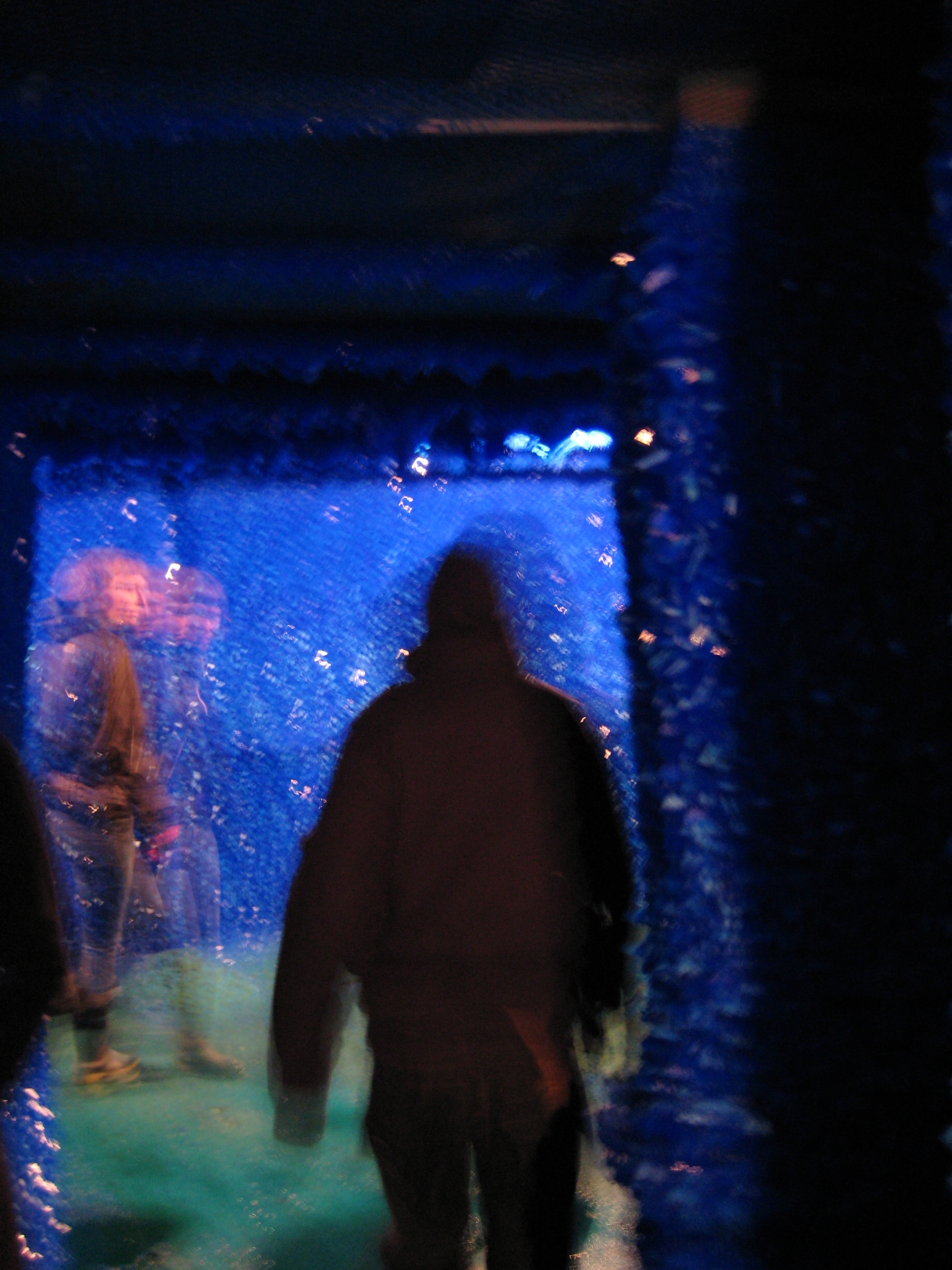
Roger Hiorns’ crystal house is probably the maddest of them all, a entire council flat flooded with copper sulphate solution, which is left to crystalise before being drained. It’s a very weird experience, a bit like entering Narnia through the wardrobe. First you wander down from Elephant and Castle, home to the most un-shopping centery shopping centre, along the New Kent Road, whose council blocks now appear to be little more than facades for this year’s incarnation of futuristic local authority bruto-chic, until you find the most boarded up two storey horseshoe shaped set of flats you can. You then stand there for an hour waiting for your turn to try on a set of some old geezer’s gumboots, before joining another queue to actually get into the flat. If you didn’t know better you’d think that there was some kind of secret stalinist indoctrination going on, an artistic linkage of the queuing process and the rotten environment you’re locked into.
It’s like a twisted Santa’s Grotto, all sparkley and gem-like and bloody cold too the day I went to see it. You stumble around in what could either be Blue Santa’s elves’ urine or more likely undrained copper sulphate runoff (hence the gumboots), while indiscriminate shapes of other visitors fade in and out of view. And you find yourself gazing into individual hunks of fist sized crystal mummuring ‘mmmm, my precious’ over an over like a demented Gollum. The overall effect is a bit like being entombed in one of Joseph Beuys’ huge felt installations, where all sound and sensation have been damped out of existance. Standing inside a Beuys installation was the nearest thing to being down a mine, said Arthur Scargill in possibly his only genuinely coherent moment. Standing here is even closer, because unlike a wall-full of felt, it actually looks like you could mine something here.
It’s the sort of thing that makes you wonder why there isn’t more of this stuff, or indeed, why they’re demolishing this at the end of the month. It’s the exact opposite of Whiteread’s internal spaces, which solidified the spaces inside a building, but prevented you from entering them. This concretises the surroundings (or more accurately, copper sulphatises them), allowing you to move around, but at the same time shows you a barren, poisonous, thoroughly alien landscape within that forces your mind to think about the nature of the space. Awesome. |