| Jul 17 |
Author ArchivePalace Tweets 2011-07-17
|
| Jul 17 |
Author ArchiveTour de France: The Elephant On The BicycleSo here we are two weeks in and so far we’ve seen the fantastic Thor Hushovd carry the Yellow jersey for the first week and the outstanding Tommy Voeckler hold onto it for the second. Current wisdom suggests that neither will win it, despite Tommy carrying it all the way through the Pyrenees without losing any time. Yet so far none of the supposed main contenders have shown the slightest interest in actually competing for the damn thing. Aside from pushing themselves in the second day’s team time trial, where perpetual nearly man Cadel Evans lost out to Thor by a second, none of the big boys have done anything remotely imposing so far. Indeed, their only notable contributions appear to be crashing out (Wiggins – assuming we class Wiggins as a big boy rather than a middleweight contender), losing time (Contador – not once but twice) and generally failing to show themselves. Instead they sit in the front end of the peloton, like corpulent lions or 16th Century soineurs, gazing over the other riders before cherry picking out the ripe young ones to satisfy their repulsive lusts. You would have thought that after two weeks one of the would have put their heads up and actually tried to at least challenge for a stage win (note to big boys, Thor won the second Pyrenean stage in spectacular fashion, while Tommy led a stage-long breakaway to take the Yellow jersey). So far all we’ve seen of Cadel is that he’s happy to come in third in the bunch, that neither of Team Schleck has the balls to dominate the race and that Contador seems happy to leave the Pyrenees four minutes off the pace, without having made one single significant attack. The truth is that for two weeks these guys have gone missing. Certainly in comparison with previous recent champions like Armstrong or Indurain, none of these boys looks worthy of leading, let alone winning the Tour. It would be a travesty if these guys simply trundled over the alps and left it to the final time trial to sort out a winner. No. All the va-va-voom in this year’s tour has come from the unexpected side of the tracks. Thor mutating from a Green jersey winner into a great World Champion, Tommy retaining the Yellow jersey over and over again despite everyone telling him he will lose it, new boy Vanendert fighting his way to not one but both Pyrenean mountain finishes, coming second in the first and winning the second, and tragic Frenchman Jérémy Roy fighting his way into nearly every breakaway of significance prior to almost winning the second Pyrenean stage and being pipped to the post by Thor Hushovd. These guys are the true heroes of the tour so far. Here’s hoping one of these guys takes the Yellow all the way to Paris. Because on form so far none of the big boys deserve it. |
| Jul 10 |
Author ArchivePalace Tweets 2011-07-10
|
| Jul 03 |
Author ArchivePalace Tweets 2011-07-03
|
| Jun 26 |
Author ArchivePalace Tweets 2011-06-26
|
| Jun 21 |
Author ArchiveWhat We Learned From Young Engerland vs Czech Republic (1-2)Lies, Damn Lies And Statistics While it’s undoubtedly a good thing that a bit of intellectual analysis is being applied to football, in particular the increased use of in-game/prozone style statistics to monitor a player’s activities over individual matches and seasons, there’s a danger of developing a simple set of ‘dumbed down’ numbers that are positively counterproductive. 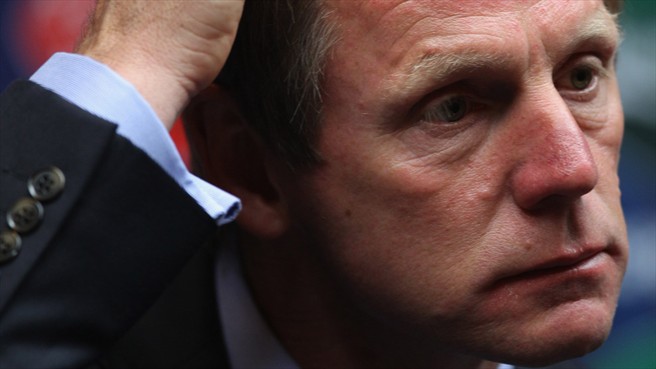 Young Engerland manager Stuart Pearce seeks inspiration as those pesky Czechs sneak another goal past his side. Take, for instance, the much over-used ‘possession’ stat. Scorelines aside, it’s close to becoming the single number that defines a team’s performance, a get out of jail free card should the team lose – ‘well, we had the bulk of possession and were unlucky to lose’ – or a great defence – ‘sure we were under the cosh, they had 75% of possession, but we battled through to a win’. But the truth is that possession is not a simple number. As has clearly been shown in this Under 21’s Championship. It ain’t how much possession you have, it’s what you do with it. It’s almost as if we should have another stat, Effective Possession. Take the Young Engerland vs Spain match, Spain had 65% or more possession, dominated the game, yet still only managed to get a draw by virtue of a deliberate handball. Hardly the stuff of dreams. So much so that it spawned Engerland manager Stuart Pearce’s comment that ‘if we had 60% of possession, we would be winning games four or five nil’, a remark that is bound to come back to haunt him, if it hasn’t already. Not least from this game, where it was Engerland who had 64% of possession, but were fundamentally unable to impose themselves on the game. Possession Is As Possession Does It all comes down to what you do with possession. The Czechs it seems were happy to give possession to Young Engerland, knowing that Young Engerland were incapable of doing anything significant with it, and for the millionth time, simply passing the ball aimlessly around the back four as they try desperately to figure out what they’re supposed to do with the strange round white thing at their feet doesn’t count as effective possession. Sure Young Engerland scored, but it wasn’t until the 76th minute, and once they did things appeared to fall apart. The Czechs, with their progress to the semis in doubt, immediately changed their tactics, pushed forward and eventually equalised. Then, with Young Engerland forced forward in a desperate attempt to score so that they would qualify, the Czechs applied the hammerblow and scrapped in a winner. You could call it unlucky, but the reality is it was an accurate reflection of a side who simply can’t control games. Young Engerland Beset By Familiar Failings Once again, Young Engerland came across as having all the qualities and failings of the senior side. A bunch of undoubtedly talented individuals who somehow become less than the sum of their parts when put into a team. A team (and I include both the players and the management team here) who appear to have no tactical understanding, no ability to shape or change a game and no ability to react intelligently to on pitch events. You sensed that there was no concept of how to effectively manage the transitions of the game, to move from defence into possession, into attack. No understanding of what the strengths and weaknesses of their opponents were and how to effectively deal with or exploit them. And no thought as to how to make these individuals gel into a genuinely strong team. Once again, an English team is defeated by the tournament process. We seem to have got to grips with the qualification process, which in itself is no mean feat given that neither France, Germany, Portugal nor Italy managed to get through, but we haven’t yet mastered the experience of tournament football. Pearce looks like a manager who is adept at selecting the most talented 11 individuals for a match (although his choice of Mancienne as a holding midfielder was a classic case of finding a square hole to keep his captain on the pitch), but not the best team. And for qualification, that’s probably all that’s needed, after all any single qualification match is going to be dogged by inevitable injuries and pull-outs, so the team pretty much picks itself. In tournament football, where you have a squad of players, you have to build a team. Statistically speaking, Loserpool’s new wunderkind, Jordan Henderson, may be every bit the £20 million manboy talent they think he is, but if he can’t link up with Smalling and Jones in defence providing a conduit to the attack, then he’s a lot less useful to this team. Similarly, if the defence can’t find a way to move the ball forward other than bloody minded hoofery, they’re only fulfilling half of their responsibilities to the team. Welbeck and Sturridge may have the most effective movement of any striker in the world, but if the midfield can’t supply them the ball occasionally, there’s something seriously wrong with the system. Increasingly we’re hearing a lot of talk about ‘footballing brains’, as if they are somehow different from the brains that ordinary mortals like you or I are issued with at birth. But the truth is that both players and managers should be judged less by the brains they have than the choices they make both during and around a game. Pearce’s choices of Mancienne in an unfamiliar midfield holding role and Henderson in central midfield appear to have been poor and his decision to stick with both of them throughout the Ukraine match seems to show a lack of both adaptability and imagination. Lansbury might appear reluctant to leap into a tackle unnecessarily, but he was much more effective than Henderson at moving the ball into dangerous positions. Lessons For Engerland (Young And Old) Great teams, tournament winning teams, adapt as the tournament develops, subtly altering structure and formation as they search for the perfect fit. And, inevitably, they are rarely simply the 11 best players or the 11 fully fit players you get during qualification. We think of Jimmy Greaves, undoubtedly Engerland’s most skillful player at the time, who played not a minute of the 1966 World Cup final, but more recently neither Fernando Torres nor Cesc Fabregas started for Spain in last year’s World Cup final and it was Villa, rather than Torres who grew into the striker’s role as the tournament progressed. Indeed Torres, like Greaves before him, found himself being edged out of a team that was somehow more effective when his mercurial talent wasn’t there. Indeed, Spain typify the kind of adaptation that teams need to display to win tournaments. Their initial loss to Switzerland provoked something of a crisis of confidence, challenging the entire playing ethos of the team. And the Spanish adapted, using fast, mobile substitutes earlier on in the game, when their opposition had become worn down by their attacking possession play and space opened up. And, increasingly, it was Torres who was sacrificed for players like Llorente. Too often Engerland, Young and Old, are seduced by the cult of the individual, the delusion of the ego. We spent years (entire championship cycles) trying to adapt our formation so that both Lampard and Gerrard could play in the same side, deluding ourselves that two players who fundamentally play the same position, could be accommodated without damaging the team by making at least one of them (frequently both) play out of position. We invent an entirely spurious ‘left wing’ problem because we have to have somewhere to put our extra midfield ego. And still, it’s enough, thanks to seeding and the relatively forgiving nature of the qualification process, to get us to the main event. However, once there, the game moves beyond the egos of individual qualification matches to the team-focused requirements of the tournament. And there we fail. Somewhere around the last 16 mark, as we gaze doe-eyed at the superior teams ahead of us. This Young Engerland side wasn’t bad. They qualified, beating some relatively serious countries along the way. And, yes, they were in a challenging group. But in three games, they never once looked like seizing the moment, imposing their will on a game or being realistic contenders. And that’s a harsh lesson to be taking away. It’s going to take a long, long time to sort out the fundamental failings in the system. So we’d better start right now. |