| Jul 23 |
Who Really Won The Tour de France?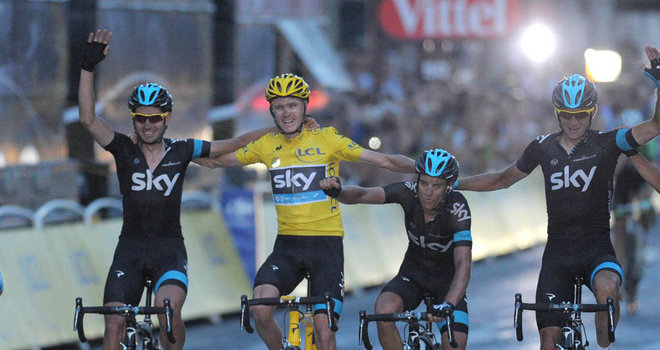 “I think that’s it guys, you can take the stabilisers off now,” Now That Was A Tour de Force After last year’s golden daze of cycling mayhem, a first British TdF winner followed immediately by a hugely successful cycling Olympics, it was always going to be hard to get a better Tour. However, this Tour has exceeded all expectations. Finally visiting every single French Department (check), outstanding drama from the word go (check), brief punch through the Pyrenees (check), cross winds and echelons (check) and a kick ass finale up some really big alps (double and sometimes treble check). And finally the kind of spectacle that only the French can provide going down the Champs-Élysées and round the Arc de Triomphe. This Tour had everything. So really it was the Tour that came out on top. The rest are merely basking in its shadow.
Best Team What with the Team Time Trial coming at such a decisive stage (that lack of a prologue stage really got things going), this was a Tour for the teams. From Orica Greenedge nipping in to take the TTT and the Yellow jersey, to Cannondale seizing the day (and the Green jersey) on Stage 7, to Sky’s dominance on the first Pyrenees Stage, to Garmin Sharp and Movistar’s Sky crushing response the day after, to Belkin and Omega Pharma Quickstep shredding the peloton on Echelon Day and Saxo Tinkoff taking advantage in the closing stages, this has been a great Tour for teams and team tactics, in particular risky attacking tactics. Surprisingly, my best team isn’t Sky. Unlike last year when they were imperious, this year they’ve shown themselves to be vulnerable, probably a reflection of the hugely demanding nature of this year’s Tour. Instead my best team is one that made two of the worst tactical decisions in the entire race, yet still went on to eliminate all their rivals bar Sky. With 3 wins, two jerseys and the runners up spot, my best team is Movistar. Worst Team If you believed the stats, there were 22 different teams in this year’s Tour. Now, while some of them are the kind of wildcards that typify the English entrants at Wimbledon, Europcar, Française des Jeux, Sojasun, there are others that are bone fide tier 1 teams. And while it’s excusable for all of FDJ’s riders to have been disappointing, it’s not acceptable for the latter to have been all but invisible for the entire tour. Step forward, in shame, Astana, BMC (who might have preferred to be totally invisible given the terrible Tour they had), Cofidis, Euskaltel, Lampre and Vacansoleil. Barely any riders in the breakaways, let alone the pointy ends of the race, some of these teams should be banned in future. But top of the heap (or bottom if you like) were Lampre. I can’t recall view or mention of a single Lampre rider in any of the 21 stages. Plus they’ve now been indicted for doping in Italy, which must take some doing. Let’s hope we don’t see them again. Winner And Best Rider Not as easy to judge as it might seem. 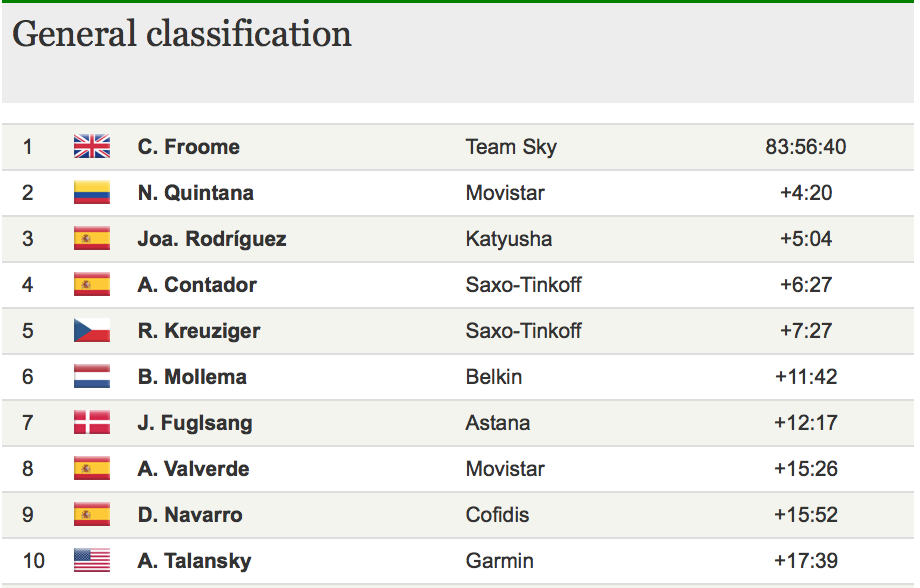 Them’s the breaks – the final standings in the Tour de France 2013
Froome vs Wiggo You might wonder why, given we’ve had just the two British winners of the Tour, we should be so quick to attempt to rank them. But it is inevitable that we are going to compare Froome’s victory this year with the success of Wiggins in 2012. First, because of the amazing similarities. You have a rider admirably suited to the Tour route (last year lots of time trials and not too many mountains, this year lots of mountains and not too much time trialling), backed up by a highly focussed backroom staff and supported by some of the best domestiques in the business. It was illuminating to see Froome have two moments which closely mirrored those of Wiggins the year before. First, there was the moment of ‘crisis’. For Wiggins, this was when he was comfortably leading the Tour and Froome felt he could sprint away (and did, leading to a year’s worth of Froome vs Wiggo arguments). For Froome it was his hunger crash on the second ascent of the Alpe d’Huez. At this point his no 2, Porte, was undeniably stronger but fortunately for Froome was over 20 minutes down on the GC. Both moments showed the vulnerability of the Yellow jersey. The second was the inexplicable moment of ‘clarity’, when it hits them that they have actually won the Tour and they momentarily lose it a bit. For Wiggins it was the moment that he and Froome had finally distanced Nibali and he realised he had won and he lost himself in a barrage of thoughts about all the people who had helped him get there and thus potentially lost the opportunity to win the stage. For Froome that moment happened on the final climb of the Tour, when he could have outsprinted Quintana and Rodriguez to win both the stage and the King of the Mountains. Instead he was overtaken by the moment and lost that magic 1% that separates the legendary from the great. It seems gauche and rather irksome to compare them. They are both great Tour winners and epitomise the best of individual and team sportsmen. Yet, no matter how great the achievement of Froome, he can’t escape the fact that he wasn’t first, he didn’t lead the last rush into the Champs-Élysées before a winning Cavendish sprint and then win Olympic Gold just over a week later. He will always have Mt Ventoux and that spectacular finish, but, you sense, they’ll never give him his own gold throne. 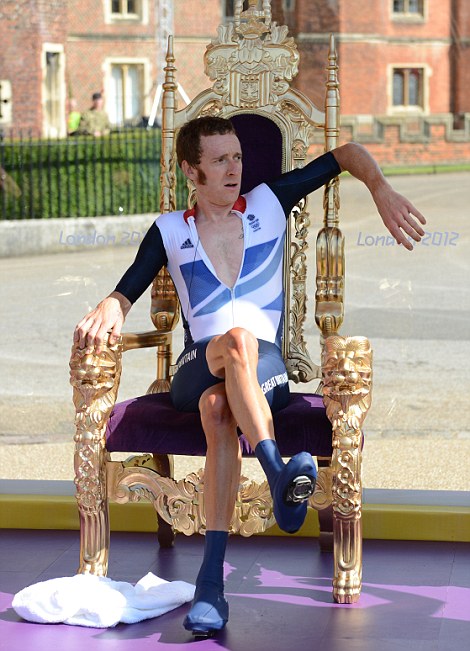 Hey Ho, Who’s the Daddy? |